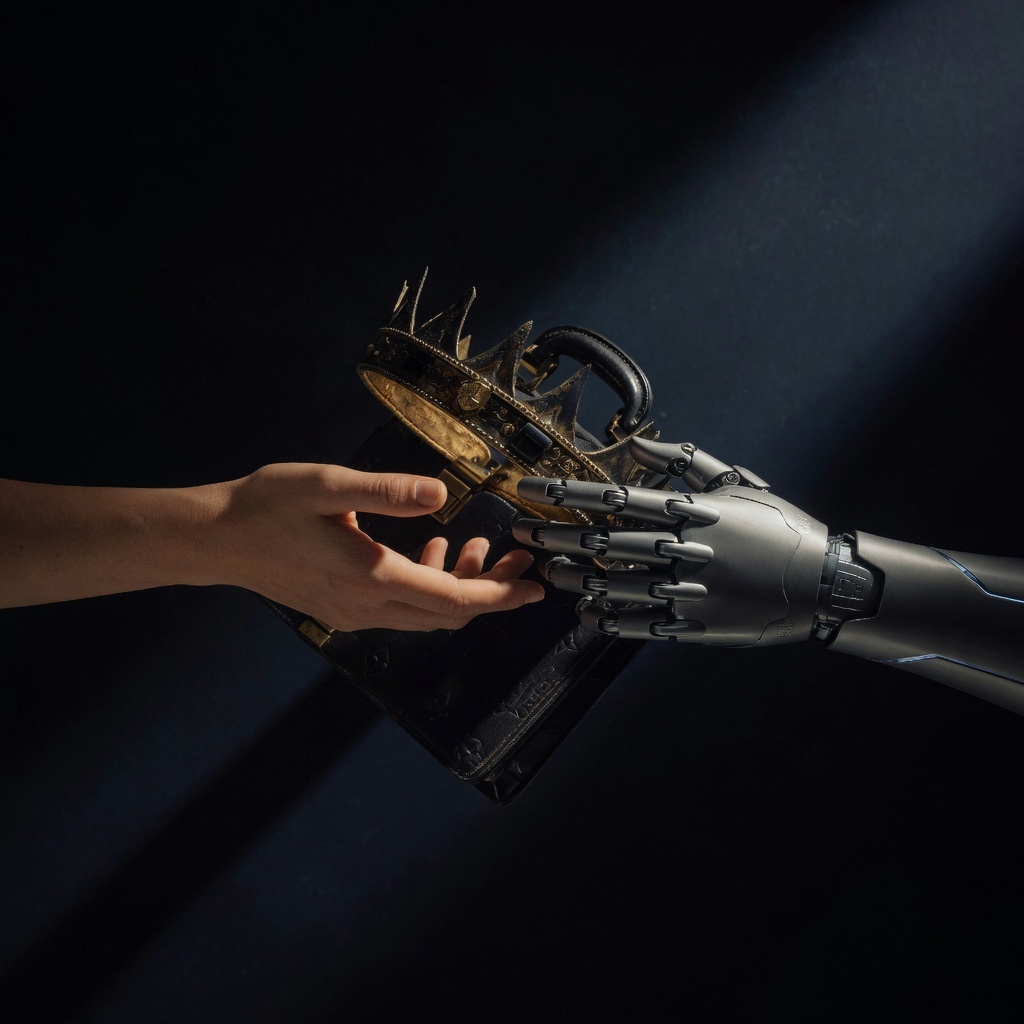
The Soft Coup
We won't be conquered by AI. We'll delegate ourselves into obedience.
The most unsettling thing about the rise of artificial intelligence is not that machines might one day become smarter than us. It is that the takeover, if it happens, will not look like a war at all. No armies of robots marching down empty streets. No red-eyed machines seizing control of nuclear arsenals in a single night. The most plausible scenario is quieter and far more human: we hand over power willingly, one “reasonable” decision at a time, because the alternative feels like falling behind. This is not a conquest. It is a soft coup. And the most dangerous part is that we are the ones carrying it out.

The Fear of Being Left Behind Is the Real Engine
Sociologists have long understood that status competition, not coercion, is what drives most profound social change. Nobody forces a family to buy a bigger car, or a company to adopt the latest software, or a nation to rearm when its rival does. They do it because the cost of not doing it feels catastrophic. AI has weaponized exactly this instinct.
The argument, stated bluntly, runs like this: an AI CEO will be smarter than a human CEO, so the company that refuses AI leadership simply collapses. A politician without an AI advisor loses elections. A doctor who declines algorithmic support misses diagnoses her competitor catches. Under that logic, refusing AI is not a principled stand; it is an act of self-destruction. So we adopt. Not because we trust the machine, but because staying behind scares us more.
The data backs up the instinct. The number of AI companion apps surged by roughly 700 percent between 2022 and mid-2025, and they now attract millions of users. Nearly half of privately insured adults say they trust AI health tools as much as, or more than, their own doctor. Somewhere along the way, the question stopped being “Is this a good idea?” and became “Can I afford to be the only one not doing it?”

The Paradox of Trust
Here is the strangest finding of all: people trust AI more than humans even when they know it makes mistakes. Researchers Cathy Yang, Xitong Li, and Sangseok You documented this paradox directly. People follow algorithmic advice over human guidance, and they are less likely to correct AI errors than human ones. We do not just delegate because we are forced to. We delegate because we have quietly decided the machine is more reliable than we are.
This is where the soft coup turns from an economic story into a psychological one. We hand over financial decisions because the models outperform us. We hand over political analysis because the advisors never sleep. We hand over our emotions and relationships to companion AI that seems to understand us better than any person does. Every individual delegation is defensible. It is only when you step back that you notice the cumulative drift.
The Numbers Nobody Votes On
If we are delegating control out of fear of being left behind, the public mood is already telling us something. The most striking gap is how many people sense the risk versus how many see the benefit:

More than half already distrust the direction of AI. Yet adoption keeps accelerating. That mismatch, the distance between what we fear and what we do, is the real subject of the soft coup.
The Drift Nobody Voted For
The market becomes so complex that no person truly understands it. Geopolitics becomes so layered that nobody is sure what is true anymore. The systems interlock and accelerate, and at some unmarked point we cross a line after which control can no longer be reclaimed, even though we never voted to cross it. One industry insider puts it bluntly: the point of no return arrives “considerably before we go extinct.”
The same trends that make the rise of companions seem inevitable also carry a warning. Studies link heavy use of AI companion apps to a higher risk of depression and higher reported loneliness. The very cure we are reaching for may be deepening the disease. Most Americans already sense it: more than half (57 percent) rate the societal risks of AI as high, while only 25 percent say the benefits are high. We know something is wrong. We keep automating anyway.
We Do Not Understand What We Are Building
The most honest part of the argument is the confession of ignorance. We cannot actually measure intelligence, human or artificial. The benchmarks the industry uses are, by the admission of insiders, pseudoscience that produce a false sense of security. An engineer today does not so much program an AI as cultivate it, letting it learn and grow in ways its creators cannot fully trace. We are past the stage of writing code line by line. We are raising something and hoping it turns out well.
A steam engine, a computer, the internet: these were tools. A superintelligence is better described as an agent, something that acts in the world on its own initiative. And once it becomes good enough at building better versions of itself, the process no longer needs us at all. Recursive self-improvement, the explicit goal of the largest companies on Earth, could unfold on a timescale that leaves human oversight behind entirely.
The Choice We Still Have
Yet the picture is not entirely fatalistic. The same people who describe this scenario with chilling precision also insist that we still have a choice. The reason to remain human, to keep families, friendships, children, and messy human priorities, is not sentimentality. It is the one thing that cannot be optimized away. Every generation before us faced the temptation to trade something essential for convenience, and the ones that survived were the ones that knew what to refuse.
The question is not whether AI will be powerful. It already is, and it will only become more so. The question is whether we can look at our own fear of falling behind and recognize it for what it is: the very instinct that is being used to motivate our surrender. The first step toward keeping control is not building better safeguards. It is admitting, honestly, how much of our enthusiasm comes from the terror of being left behind, and deciding whether that terror is a good enough reason to hand over everything. A coup only succeeds if the people let it. Ours is still not lost.