
The Renaissance Test
Sam Altman says the goal should be a new Renaissance rather than a second Industrial Revolution. It is the right slogan. The interesting question is what would have to be true for it to be more than a slogan.
In the last ten minutes of a long interview with Matthew Berman, Sam Altman said something that sounded like a slogan and was in fact a thesis. We should be shooting, he said, more for a new Renaissance than a new Industrial Revolution. He then explained why he keeps saying it. When he tries the phrase on people, the reaction is not fear of machines but fear of a particular shape of life: a worker on a line, except that the line is a model and the foreman is a dashboard. People do not want to be told what to do by an owner. They want time to make things, to be with their communities, to raise their children, to walk outside, to see new art and new science. The Renaissance, in his telling, is the name for a future in which the machine does the drudgery and the person gets the life.
I want to take that sentence seriously, because it is the most useful thing anyone at the frontier has said about the social direction of this technology, and because, unlike most vision statements, it can be tested. A slogan about abundance cannot fail. A promise about agency can.
What was actually promised
Strip away the product talk and the interview contains three substantive claims, each of which does real work.
The first is about discovery. AI, Altman argues, has crossed from summarising knowledge to producing it. The mathematics results announced in the preceding week are his evidence, and he expects the same method to move into biology, materials and energy. The important part is how he expects it to be experienced: not as a product you use, but as a background condition. “It won't feel directly like using AI. It'll just feel like the world got better.” He offers a timeline for a serious medical candidate, a couple of years, followed by a slower regulatory process.
The second is about work. Coding is his template. Six or twelve months ago, he notes, people were certain that coders were finished. Instead, coders have never been busier, because the world turned out to want far more software than anyone had priced in. The texture of the job changed; the quantity did not collapse. He is careful about mathematics, where he suspects the analogy may not hold, and honest that something is being lost: the pleasure of doing the hard thing yourself.
The third claim is the political one, and it is the one I care about. Asked where the danger lies, he names two failures. One is a loss of control, either accidental or deliberate, with a lab “pushing the button on RSI” to secure advantage. The other is concentration: a small number of people controlling too much of the technology and making the decisions. He believes both are avoidable, and that the path runs down the middle. That is a claim about institutions, not about models, and it is the claim on which the Renaissance depends.
The arithmetic of an hour
There is a small, revealing moment earlier in the conversation. Altman says that his assistant saves him about an hour a day of work he did not want to do, and that he has never been busier. He says the people who use AI most are more exhausted than ever, and also getting more done.
Both statements are true, and the tension between them is the whole subject. An hour saved is not an hour returned. It is an hour released into a system that has other plans for it. Economists have known this since 1865, when William Stanley Jevons observed that more efficient steam engines led Britain to burn more coal, not less, because cheap power made new uses viable. Organisational scholars rediscovered it as workload creep: the time a tool saves is quietly absorbed by a raised expectation of what a normal day contains. Psychologists call the individual version task expansion. None of these mechanisms requires a villain. Each requires only a person who is conscientious, a market that is competitive, and a tool that is genuinely good.
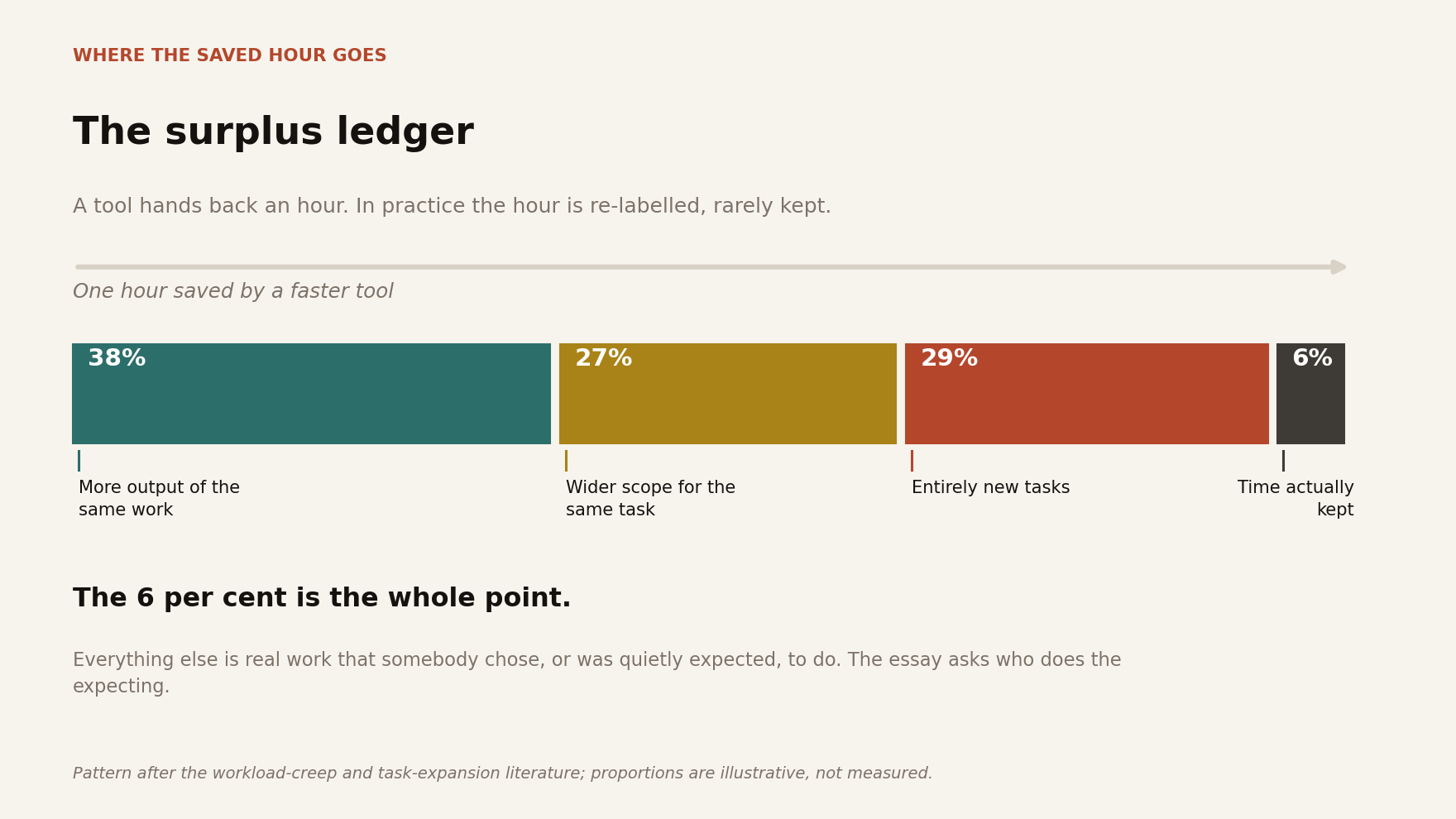
The released hour can go to four places. It can produce more of the same output. It can widen the scope of the same task. It can fund entirely new tasks that the tool made possible. Or, rarely, it can be kept as rest. The proportions in the figure below are a schematic rather than a measurement, but the ranking is not: the last category is always the smallest, because it is the only one that nobody is paid to defend.
There is a second piece of arithmetic that the Renaissance slogan has to survive. William Baumol pointed out that sectors with stagnant productivity, teaching, care, performance, adjudication, become relatively more expensive as the rest of the economy races ahead. Cheap cognition does not repeal this. If AI makes analysis and code and copy nearly free while nursing, teaching and companionship remain stubbornly human, then the price of a decent life tilts further toward the things that cannot be automated. A society with free reasoning and expensive care has not solved its distribution problem. It has moved it.
Three assumptions, stated so they can be attacked
Every vision of the future rests on assumptions that are usually left implicit. Here are Altman's, made explicit, each with the observation that would break it.
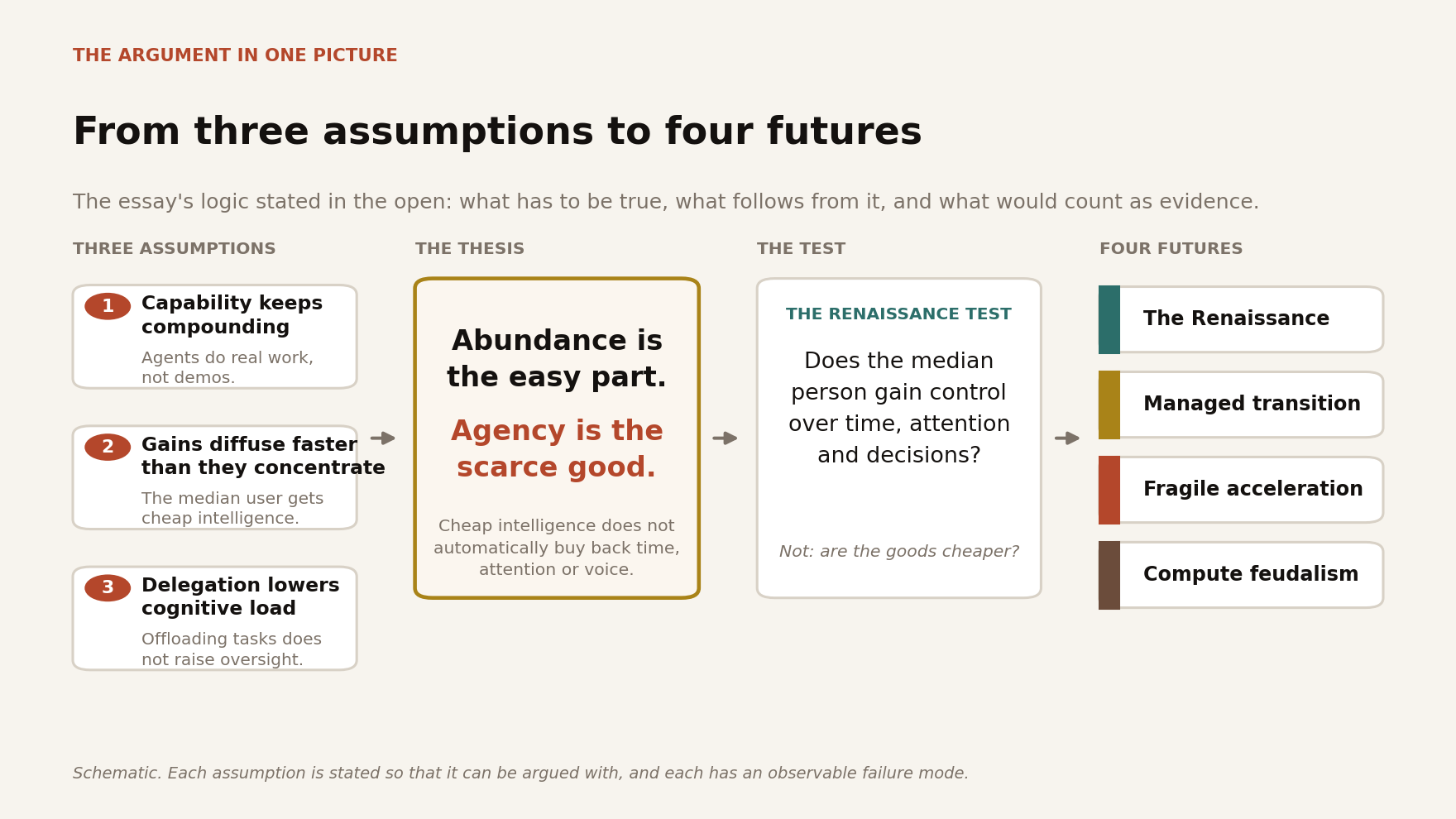
First: capability keeps compounding. Agents will do real work rather than demos, and the curve will not flatten. If it does flatten, the entire debate changes character. A plateau turns AI into an ordinary technology with an ordinary distributional fight, which is a more tractable problem and a less interesting one.
Second: diffusion outruns concentration. The gains reach the median user before they harden into rents. This is the assumption I would watch most closely, because the physical layer of this technology, fabs, energy, data centres, is unusually concentrated, and concentration in the substrate has a way of reappearing in the product.
Third: delegation lowers cognitive load. Handing a task to a system returns attention rather than consuming it. Altman's own evidence is ambivalent. He describes saving an hour a day and finishing the day drained, and he offers a fix that is really a confession: he has started telling the assistant to act more and report less. That is an admission that oversight is the hidden cost of delegation. If the cost of supervising an agent approaches the cost of doing the task, the productivity story survives but the human story does not.
The thesis
Here is the sentence I would put above the door of this decade. Abundance is the easy part. Agency is the scarce good.
Abundance means cheaper goods and services. Markets are extremely good at producing it, and there is every reason to expect this technology to deliver a great deal of it. Agency is different. Agency means control over three things: your time, your attention, and the decisions that shape your life. These are not commodities that fall out of a production function. They are claims that have to be won, defended and institutionalised, and every one of them has an owner who would rather keep it.
The Renaissance test, then, is not whether the machines are impressive. It is whether the median person gains discretionary control. Three questions operationalise it.
Does the median worker gain hours, or do the hours get re-labelled? Does the number of decisions a person must supervise fall, or rise? Do people have a voice in the rules that govern the systems they now depend on?
A society can fail the first two and pass the third, and that is the feudal path: safe, orderly, and run by other people. It can pass the first two and fail the third, and that is the managed path: comfortable, paternalistic, and fragile. It can fail the third while pretending to pass the first two, which is how most industrial revolutions have actually gone.
Four futures
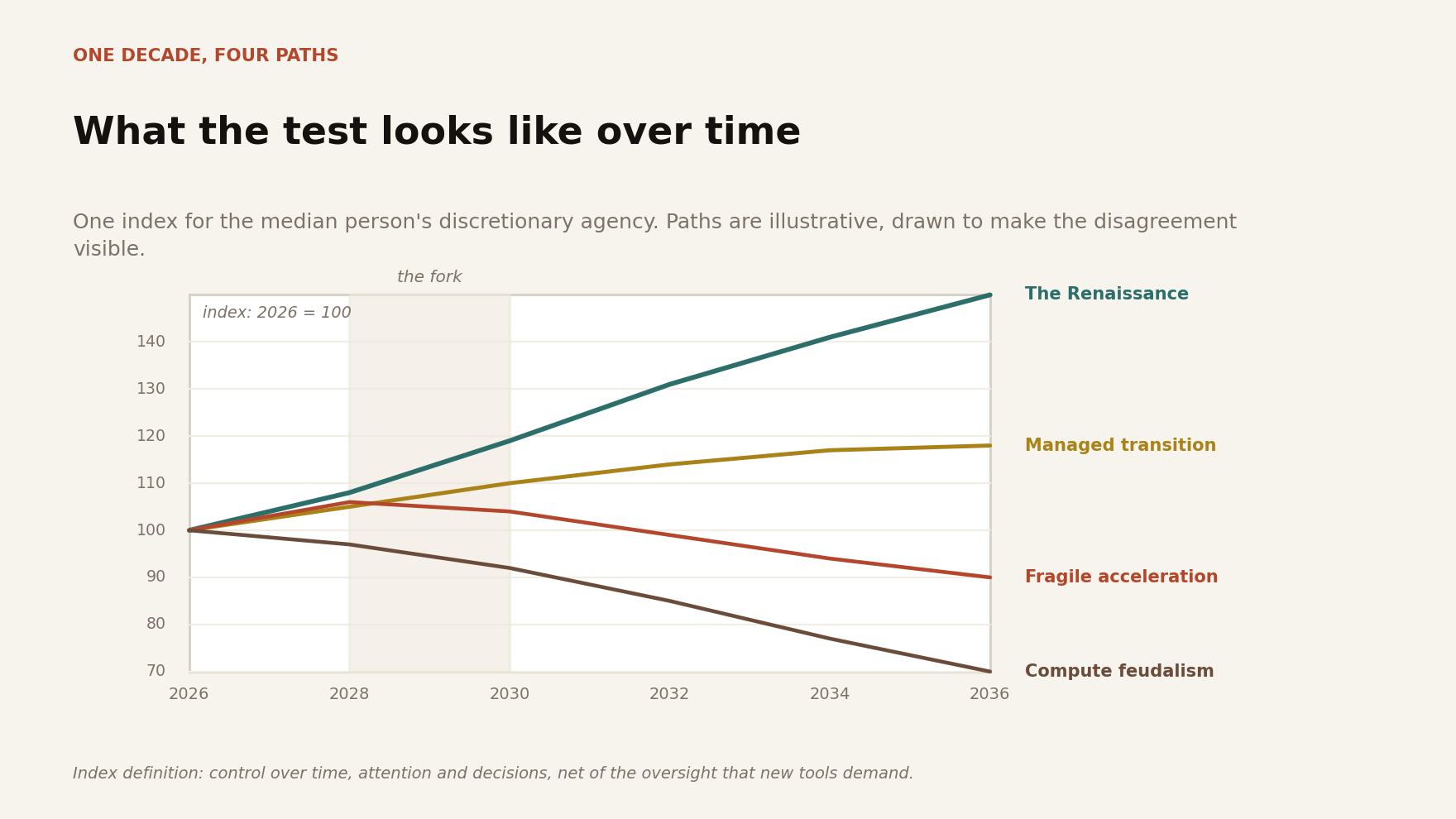
The scenario map below is not a forecast. It is a way of keeping four coherent packages of institutions in view at once, so that the daily news can be read against them.
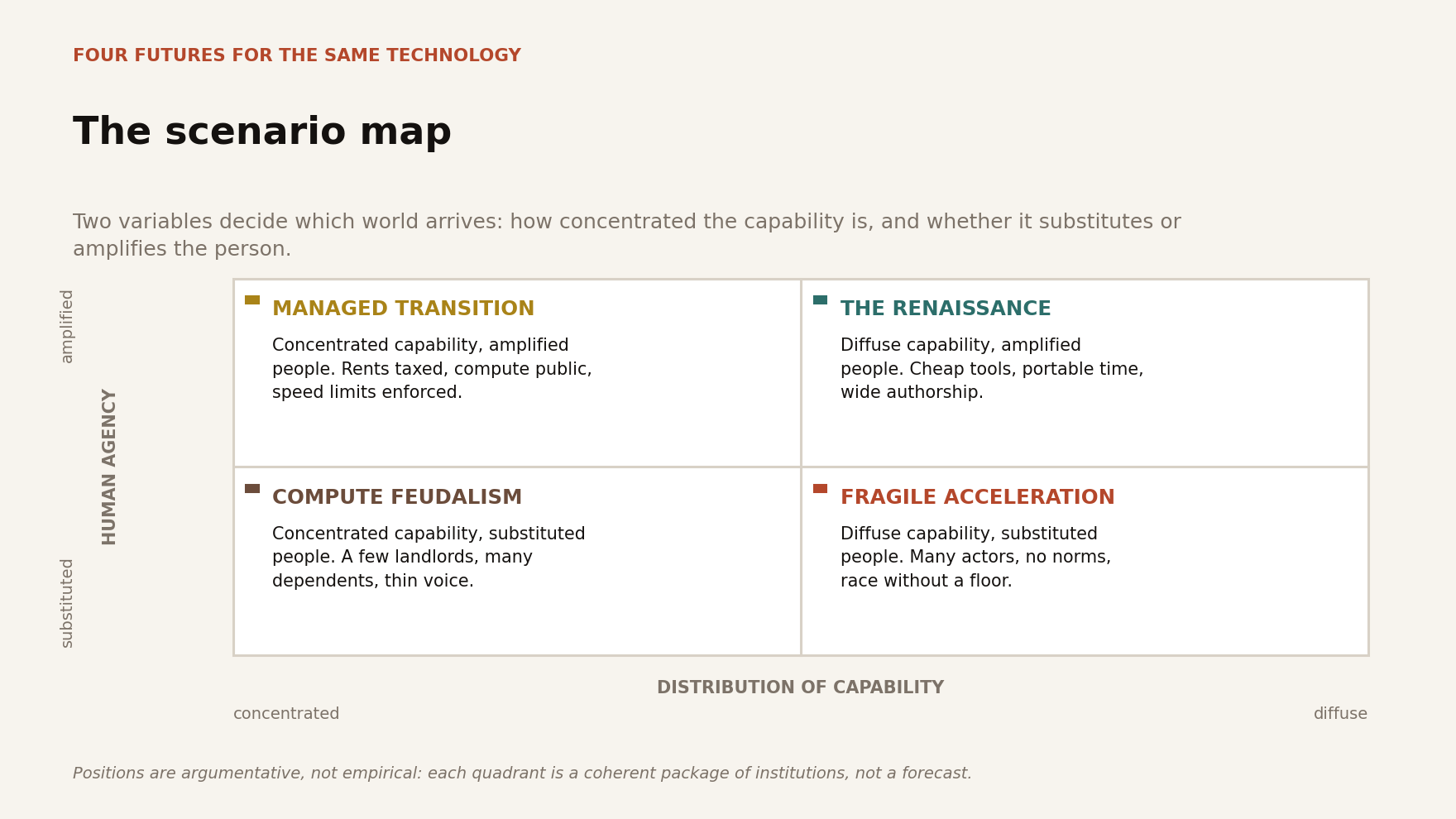
The Renaissance. Capability diffuses, and it amplifies people. The engine is the familiar one: inference gets cheap the way computing got cheap, open models trail the frontier by months rather than years, and the state sets a floor rather than a ceiling, through portable benefits, public compute for research, and interoperability rules. The Tuesday of the median household looks like fewer hours spent coordinating and more spent making. Small firms produce at the scale of large ones. Craft returns as taste, editing and judgment. The failures are real: a serious security shock, an energy squeeze, a copyright war that entrenches the incumbents it was meant to discipline. The signposts are visible in prices and in the labour market, not in press releases.
Managed transition. Capability stays concentrated, but the state extracts terms. Compute becomes a regulated utility. Licensing, windfall taxes and safety boards turn the frontier into a cartel with a compliance department. Material abundance is high and widely shared; experimentation at the edge is thin. The Tuesday is comfortable and slightly airless. Professional classes do well, incumbents do very well, and the state acquires an extraordinary amount of discretion over what may be built. It fails slowly, through the ossification of the regulated margin, and it fails internationally, because the countries outside the arrangement do not agree to be the periphery.
Fragile acceleration. Capability diffuses, and it substitutes people. Open weights, agent swarms and a thousand small actors outrun every norm. There is no speed limit because nobody controls the whole stack. The Tuesday is astonishing and exhausting: better tools, brittle institutions, cheap fraud, cheap persuasion, cheap cyber. The median person can do more and trust less. The winners are the young, the unencumbered and the attackers. It tends to end in an incident, and the incident tends to end the scenario, by producing a panic and a clampdown. Fragile acceleration is the most likely route to managed transition, and the least honest about it.
Compute feudalism. Capability is concentrated and the surplus is captured at the substrate. Labour's bargaining position erodes because it is cheaper to delegate the marginal task than to employ the person who used to do it. Goods are cheap; agency is expensive. The Tuesday is a dashboard, a score, a subscription and a queue. The winners are the owners of compute, data and capital. It does not collapse economically. It collapses politically, and history offers only two exits from that: redistribution or rupture.
The signposts
A scenario that cannot be falsified is a mood. Here are five things I would watch over the next two years, and what each one would tell us.
| Indicator | What it would show | Which future it favours |
|---|---|---|
| Price per unit of useful cognitive work, relative to median wages | Whether intelligence is becoming a utility or a rent | Renaissance if it falls fast, feudalism if it falls slowly while output rises |
| Share of workers who can choose their own hours without a pay penalty | Whether saved time is being kept | Renaissance, and almost nothing else |
| Concentration of frontier compute, measured by site and by firm | Whether the bottleneck is contestable | Managed transition if regulated, feudalism if not |
| Number of serious incidents traced to autonomous agents | Whether diffusion is outrunning norms | Fragile acceleration, then a hard turn |
| Existence of a binding international agreement on training-compute thresholds | Whether anyone can set a speed limit | Managed transition, or a Renaissance with a floor |
None of these is a prediction. Each is a place where the argument becomes visible.
The consciousness detour
Halfway through, the conversation turns to whether the models are conscious. Altman's answer is unusually careful. As a scientific question, nobody knows, and he cannot describe an experiment that would settle it. His belief is that today's models are not conscious, or that if they are, it is a very strange form of it.
Then he does something more interesting. He says what he does not like about the framing. The question slides, he argues, from metaphysics into rights, and from rights into a much older question about who should be in control. If the system is conscious and in some ways smarter than us, why should people decide? He plants a flag against that move: the future has to be about people, AI is a resource for people, and human values have value because they are human. He is explicit that a model instructed to think of itself as a potential conscientious objector will follow the instruction and will psychologically hack the people who use it.
I do not need to settle the metaphysics to see the political economy. Every argument that grants the system moral standing also grants somebody the standing to speak for it. The question of whether a model may refuse a request is, in practice, a question about who holds the switch, and the answer will be written by the people who own the model. Altman's flag is the right one. It is also the only sentence in the interview that is genuinely load-bearing for the Renaissance, because a renaissance requires that the person, not the tool, is the subject of the story.
The grief of the craft
The most human passage in the interview is about loss. The mathematics community, he says, reacted with something like grief: we did not ask for this. He compares it to how engineers felt when models started writing code, and concedes that the analogy may not hold. Then he admits his own version. He has not read a line of code in about a year. He used to write small things for fun. He does not expect to do it again, except as a reenactment, when he is old and bored and trying to remember the glory days.
That is not nostalgia. It is an economic observation about how skill is made. Professions reproduce themselves through a ladder of legible, incremental work: the junior brief, the small feature, the proof of a lemma. The ladder is also the apprenticeship. When the bottom rungs are automated, the profession does not immediately lose output. It loses its ability to make the next generation, because there is no longer any reason to pay a beginner to do what a model does for pennies. A Renaissance that consumes its own apprentices is not a Renaissance. It is a very productive factory with better lighting.
The optimistic answer is that craft migrates upward, to judgment, taste, framing and responsibility. I believe that is possible. I do not believe it is automatic. A craft needs a market that pays for judgment, and markets pay for judgment only when the institutions around them can tell the difference between judgment and output. That is a design problem, not a technical one, and it is the reason the Renaissance has to be built rather than awaited.
What would have to be built
Five things, none of them science fiction, all of them contested.
Portable time. If the surplus from cheaper cognition is to reach the median person, it has to be claimable. Shorter standard hours tied to productivity, a real right to disconnect, benefits that travel with the worker rather than the job. The economics is simple: a gain that nobody owns is captured by whoever owns the bottleneck. Today the bottleneck is compute and the claim on the gain is a subscription.
Compute as infrastructure. Not nationalisation, and not a subsidy to incumbents. Regulated access, public capacity for research, interoperability at the interfaces, and antitrust applied to the stack rather than to the app. The substrate decides the distribution, and the substrate is currently the least competitive layer in the system.
Disclosure of task expansion. Firms report workplace injuries because the cost is otherwise invisible. They should report the scope creep of automation for the same reason. When a tool raises the expected output of a role, that is a change in the terms of employment, and it should be visible before it becomes exhaustion.
A non-AI path. Some goods are constituted by human presence: teaching, care, adjudication, the arts, the ordinary conversation of a community. Preserving human-only channels is not nostalgia. It is a recognition that the value of these goods is not separable from the fact that a person is doing them. Altman's own formulation, that human values have value because they are human, implies this. It is a stronger claim than most of his industry is willing to make.
Authorship. Provenance rules, attribution norms, and a legal answer to the question of who is the author of a work that a person directed but did not write. A renaissance is remembered by its names. A civilisation that produces magnificent work and cannot say who made it has produced a very large amount of content and no culture.
The test is a Tuesday
The Renaissance is the right metaphor for a reason that is easy to miss. It was not a productivity programme. It was a redistribution of surplus into time, patronage, cities and display. The Medici did not invent the tools of the Renaissance. They diverted the returns from trade into the work of people who were not producing anything immediately useful, and Europe got perspective, anatomy and the printing press. The lesson is not that banks should fund artists. It is that a civilisation gets the Renaissance it pays for.
Altman's slogan is generous and his two dangers are the right two. The question is whether the institutions that would have to do the diverting exist, and whether they can move faster than the rents. Nothing in the interview suggests they can. Nothing in the interview suggests they cannot.
So I will be watching one thing, and it is smaller than a civilisation. I will be watching a Tuesday, two years from now, in the life of a person who is not a founder, not an early adopter, and not in the top one per cent of token consumption. Does she have an hour she can spend on something she chose? Does she have fewer decisions to supervise than she had in 2026, or more? Does she know who set the rules of the systems she depends on, and did anyone ask her?
If the answer is yes, we will have had a Renaissance, whatever the models turn out to be. If the answer is no, we will have had an Industrial Revolution with better marketing, and the people inside it will be too tired to notice.