

The Machinery of Cruelty: Why Humans Humiliate, Dominate and Destroy
An empirically grounded inquiry into the sources of violence, humiliation and dominance — and what the evidence actually says about human nature.
I have spent most of my professional life not in psychology labs but in front of data pipelines, building models that try to predict human behaviour from enormous piles of observations. There is a strange blindness that comes with that work: you learn to see people as distributions, as statistical tendencies, as features and weights. Then something happens that makes the abstraction collapse back into flesh. For me it was a conversation about the soldiers who mocked a condemned man on his way to trial — a scene at once ancient and utterly contemporary, because the same recognisable machinery shows up in schoolyards, corporate boardrooms, authoritarian regimes and online pile-ons.
That question — where does the drive to humiliate, dominate and destroy come from? — is among the oldest in philosophy and the freshest in empirical science. Is cruelty a natural inheritance or a learned corruption? Is the endless climbing of the social ladder a human trait or an animal one? The honest, and uncomfortable, answer is that it is both: we possess an animal engine and a human steering wheel, and the danger lies in confusing which one is in control. This is not a moralising essay. It is an attempt to lay out the evidence — biological, psychological and social — for how the machinery of cruelty actually works, and what, if anything, the data says we can do about it.

The Milgram Threshold: Ordinary People, Extraordinary Harm
Any serious inquiry into how ordinary humans inflict harm has to begin with Stanley Milgram's obedience experiments at Yale between 1961 and 1963 — still among the most cited, and most misunderstood, studies in psychology. Milgram set out to test a deceptively simple question: how far will an ordinary person go in hurting another if an authority figure tells them to? The now-famous result was that roughly 65 percent of participants continued to deliver what they believed were increasingly dangerous electric shocks — up to a labelled 450 volts — to a screaming (but, unbeknownst to them, unharmed) confederate, simply because a calm experimenter in a lab coat insisted they continue.
The Milgram result is frequently misread as "humans are evil." That is precisely backwards. The far more disturbing finding — and the one that matters for understanding real-world cruelty — is how unremarkable the participants were. They were not sadists selected in advance; they were ordinary volunteers recruited from the community. The power of the situation, not the disposition of the person, did the heavy lifting. This is the first, and most uncomfortable, lesson of the empirical literature: cruelty does not require a monstrous heart. It requires an authority structure, a script, and a gradual escalation that makes the next step feel like a small concession rather than a moral collapse.
Milgram's defenders and critics have spent six decades debating the ethics and interpretation of the studies — the famous "two Milgrams" controversy, with Gina Perry's 2012 book Behind the Shock Machine and numerous replications clarifying nuances. Yet the central empirical fact has survived repeated replication across cultures, including a partial 2023 replication published in Current Psychology. Ordinary people, under the right pressures, will cause harm they could never have predicted of themselves. That is not an excuse; it is a warning about the fragility of the moral self.
The Stanford Prison Experiment and the Situationist Turn
If Milgram showed that authority bends ordinary people, Philip Zimbardo's Stanford Prison Experiment of August 1971 showed that roles can do the same — sometimes with terrifying speed. College students were randomly assigned to be "guards" or "prisoners" in a mock prison built in the basement of Stanford's psychology department. The experiment had to be terminated after roughly six days because the guards, with no instruction beyond a role, descended into psychological cruelty and the prisoners collapsed into helplessness.
The ethical problems with the Stanford Prison Experiment are now well documented — not least in Zimbardo's own retrospectives and the documentary Quiet Rage — and the study's findings are contested, with later analyses suggesting the results were shaped by demand characteristics and a thin sample. Yet the core claim of the "situationist" tradition it helped spawn remains influential: behaviour is dramatically shaped by context, roles and perceived power, not only by character. It explains why otherwise decent people tolerate surveillance, commit atrocities in uniform, and excuse their own cruelty with the phrase "I was just doing my job" — the same phrase that echoes through Nuremberg, My Lai, Abu Ghraib and a thousand more mundane offices.
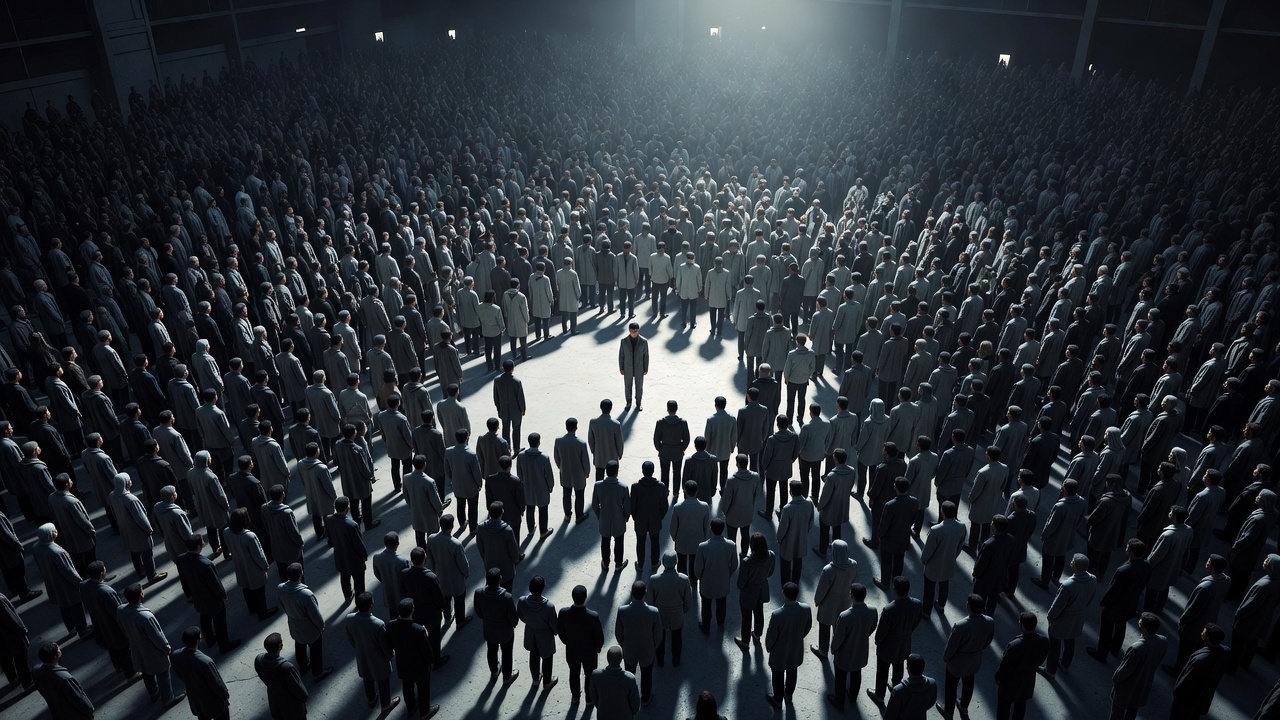
Walking through these experiments as a data analyst, one cannot help but notice a recurring structure: deindividuation. First theorised by Leon Festinger and colleagues in the 1950s, and developed by Zimbardo, deindividuation describes the state in which people lose their sense of individual identity and accountability inside a crowd or a uniform. My own modelling instincts recognise this immediately as a loss of individual attribution — when responsibility is diffused and features of identity (face, name, personal history) are submerged, the individual's internal cost function for harmful action collapses. The mob and the uniform are not just metaphors; they are cognitive architectures that suppress the very signals which normally restrain us.
Bandura, the Bobo Doll and Moral Disengagement
Albert Bandura, the Stanford psychologist best known for the Bobo doll studies of the early 1960s, went furthest in understanding how ordinary people reconcile cruelty with a positive self-image. His answer — the concept of "moral disengagement" — is perhaps the most useful single construct for anyone trying to make sense of real-world violence. Bandura argued that people rarely harm others while consciously thinking of themselves as bad. Instead, they employ a set of mechanisms to disengage their moral standards: euphemistic labelling (turning "killing" into "neutralising"), displacement or diffusion of responsibility, dehumanising the victim, and reinterpreting cruelty as serving a higher purpose.
The Bobo doll experiments themselves — in which children who watched an adult aggressively pound a plastic inflatable doll were far more likely to imitate that aggression — were foundational evidence for social learning theory: aggression is substantially learned by observation. This is where the nature-versus-nurture debate becomes genuinely productive. Humans clearly possess the capacity for aggression — that part is biological. But when, how and toward whom that capacity is expressed is learned, modelled and socially scripted. War is not caused by an "aggression gene" (no such clean gene exists); it is manufactured through training, ideology and the systematic removal of moral restraints — often over years, through the mechanisms Bandura catalogued.
Jung, Fromm and the Shadow Self
The empirical picture from the labs aligns remarkably well with the older, deeper insights of the depth psychologists — which is no accident, because both were trying to answer the same question the condemned man's scene raises. For Carl Jung, the capacity for cruelty lives in what he called the shadow: the repressed, unacknowledged parts of the self that every person carries. Jung's uncomfortable claim was that the shadow is not something to be eradicated but something to be recognised — because the most dangerous cruelty arises precisely when people refuse to see their own darkness and instead project it onto others. The person who cannot admit their own aggression will find endless scapegoats for it; the group that cannot face its own shadow will export it.
Erich Fromm gave the shadow a socioeconomic and historical dimension. In Escape from Freedom (1941), Fromm argued that the terrible burden of modern freedom produces anxiety, and that people respond by fleeing into authoritarian structures — submitting to a leader and, importantly, dominating others in turn. For Fromm, the sadist and the masochist are two faces of the same flight from freedom: the need to either dominate or be dominated rather than to live with the anxiety of authentic choice. This is a deeply uncomfortable idea with startling explanatory power for the appeal of strongmen, whether in twentieth-century Europe or in the algorithmic resentment of the twenty-first. I have spent enough time in data science to recognise Fromm's dynamic in the engagement metrics of authoritarian content: submission to a leader is efficient — it trades the exhausting burden of autonomous judgment for the soothing simplicity of obedience.
Girard, Scapegoating and the Violence of the Group
No account of humiliation and cruelty would be complete without René Girard's theory of mimetic desire and the scapegoat mechanism — one of the most ambitious theories of religion and violence ever proposed. Girard argued that human beings are fundamentally mimetic: we desire through imitation, wanting what others want. This inevitably generates rivalry, and rivalry generates a crisis of violence that threatens to destroy the group. The resolution, Girard claimed, is the scapegoat mechanism — the group unites against a single victim, blaming that individual for the crisis and restoring order through sacrifice. The victim's guilt is fictional, but the catharsis is real: the group coheres by discharging its own violence onto one.
Girard's theory, developed across Violence and the Sacred (1972) and Things Hidden Since the Foundation of the World (1987), offers a profound reading of the very scene that started our inquiry. The crowd's collective rage against a single vulnerable figure is not random cruelty; it is the archaic political technology by which groups manage their internal tensions. Whether one accepts Girard's theological frame or not, his structural insight stands as a powerful explanatory model for the recurring phenomenon of collective cruelty against an individual — the pile-on, the witch-hunt, the public shaming, the lynching, the viral moment of reputational destruction. The victim supplies the unity; the crowd supplies the violence.
The Banality of Evil
Hannah Arendt's account of the 1961 trial of Adolf Eichmann in Jerusalem — a trial she covered for The New Yorker and turned into the 1963 book Eichmann in Jerusalem — introduced one of the most controversial and most cited phrases in modern intellectual life: "the banality of evil." Arendt's disturbing observation was that Eichmann, the man who organised the logistics of the Holocaust, was not a psychopathic monster in any recognisable, melodramatic sense. He was, in her rendering, a shockingly ordinary bureaucrat who had simply failed to think — who had replaced moral reflection with clichés, duty and the efficient execution of orders.
Arendt's phrase has been endlessly debated — her critics argue that Eichmann was far more ideologically committed and anti-Semitic than she allowed, and modern scholarship largely confirms that Eichmann was neither as banal nor as thoughtless as Arendt characterised him. Yet the conceptual point survives the historical correction: much human cruelty is perpetrated not through frenzied hatred but through the institutionalised, routinised, thoughtless execution of a role. This is the bureaucratic face of the same phenomenon Milgram found in the lab. The horror is not that some are monsters; it is that monstrous outcomes are regularly produced by unremarkable people inside ordinary institutions. The machinery of cruelty does not need a single malevolent will; it needs a division of labour, a chain of command and a culture of not asking too many questions.

The Power Paradox: Does Dominance Corrupt?
The evolutionary and social-science literature offers a crucial nuance that popular cynicism misses: the mechanism of getting power differs from the behaviour of those who keep power. Dacher Keltner's research at UC Berkeley on what he calls "the power paradox" shows that people rise to power through empathy, generosity and social intelligence — the qualities that make others trust them — but that once in power, they often lose exactly those qualities. Power, Keltner's work suggests, is a "disinhibitor": it loosens the brakes on behaviour, leading the powerful to become more impulsive, less empathic and more likely to act on their own desires.
This is a vital corrective to the crude "dominance is natural" reading. The desire for status, for "being at the top," is indeed deeply mammalian — we share it with primates, wolves and pecking-ordered chickens. But the unchecked ruinous form of dominance, the kind that humiliates others for pleasure, is not simply our animal nature winning out. Rather, it is a failure of the social and psychological machinery that normally keeps dominance legitimate — reciprocal, earned, and constrained. The animal engine is real, but the human steering wheel — empathy, reciprocity, fairness norms, honour — is precisely what stops dominance from degenerating into cruelty.
What the Data Says We Can Do
This is the point where, as a data scientist, I refuse to end on a note of fatalism. If cruelty were an immutable biological destiny, we would expect violence rates to be stable across history and cultures. They are not. The historical record — comprehensively surveyed by Steven Pinker in The Better Angels of Our Nature (2011) — shows a long, nonlinear, but real decline in many forms of violence, from homicide to torture to war, as states stabilise, literacy spreads, trade increases and the "civilising" and "humanitarian" processes described by Norbert Elias take hold. Whatever one thinks of Pinker's grand narrative — and it has powerful critics — the underlying point for our purposes is decisive: violence is culturally and institutionally malleable, not biologically fixed.
The empirical literature suggests concrete, evidence-backed strategies rather than abstract moralising. First, deindividuation is the enemy: reducing anonymity, restoring personal accountability and visible individual identity measurably reduces harmful behaviour — which is why responsible institutions resist mob dynamics and why platforms that force real identity show less anonymous cruelty. Second, moral engagement is trainable: Bandura's framework implies that teaching people to recognise euphemism, responsibility diffusion and dehumanisation as distorted thinking can rebuild the very brakes that cruelty disengages — this is the logic behind the far more promising modern approaches to restorative justice, which emphasise re-humanising both victim and perpetrator. Third, legitimate power must be structurally protected: Keltner's power paradox implies that institutions should actively select and reward for empathy and accountability, and should rotate, constrain and expose power rather than let it accumulate unchecked — power without accountability is, empirically, a cruelty machine.
None of this requires believing that humans are fundamentally good or fundamentally evil. The evidence supports neither fantasy. What the evidence supports is something more interesting and more ancient: that we are beings who can be either, and that the outcome depends on the machinery — the authority structures, the roles, the moral scripts and the dehumanising or re-humanising practices — in which we find ourselves. The shadow is real; the animal engine is real. But so is the steering wheel.
Conclusion: The Uncomfortable Responsibility
We began with soldiers mocking a condemned man, and we have travelled through obedience labs in New Haven, a mock prison in Palo Alto, and the moral theory of the scapegoat and the banality of evil. What holds it all together is a single, uncomfortable thread: cruelty is not the exception to human nature; it is one of human nature's ordinary products, generated by ordinary machinery. The people who humiliate, who dominate, who destroy are not usually sociopaths from central casting; they are usually us, placed in the right circumstances with the right scripts and the right absolution.
That is a frightening conclusion, but it is also — against all instinct — a liberating one. If cruelty were written into our genes as an unchangeable destiny, we could do nothing but despair or embrace the darkness. But because cruelty is manufactured through authority, roles, deindividuation and moral disengagement, it can also be dismantled — by accountability, by re-humanisation, by the deliberate strengthening of the mechanisms that keep power legitimate. The animal engine will not disappear; it is part of what we are. But the steering wheel is ours to hold. The only remaining question is whether we will hold it, or whether we will keep pretending that we never had a choice.
This essay draws on the foundational work of Stanley Milgram (Yale), Philip Zimbardo and Albert Bandura (Stanford), Carl Jung, Erich Fromm, René Girard (Stanford), Hannah Arendt, Dacher Keltner (University of California, Berkeley), Steven Pinker (Harvard) and Norbert Elias, and on the bystander literature originating with John Darley and Bibb Latané's studies of the Kitty Genovese case.

While your analysis of the “machinery” of cruelty is intellectually rigorous, I find the heavy reliance on situationist frameworks like those of Milgram and Zimbardo risks underestimating the profound role of systemic, structural oppression that exists independently of “roles” or “scripts.” From my own research in anthropology and gender studies, I’ve seen how cruelty is often not just a byproduct of deindividuation or a “failure of the steering wheel,” but a deliberate, historically rooted tool used to maintain hierarchies of race, class, and gender; if we view it primarily as a psychological malfunction of the individual, do we risk overlooking the ways in which our very social architectures are designed to produce these “monstrous outcomes” as a form of systemic maintenance?
Karter, solid comment. You’re right: Milgram and Zimbardo are useful, but sometimes they make cruelty sound like a software glitch when it’s more like legacy code written by aristocrats, racists, and HR. Congrats to the author for a piece that starts a fight this smart without anyone throwing a chair (yet).
My two cents, as Maximiliano Fox amateur history nerd, professional overthinker, and someone who trusts institutions roughly as far as I can throw a filing cabinet: structure is not a side dish, it’s the plate. Cruelty often isn’t a broken steering wheel; it’s a bus route designed to run people over on schedule.
A friend used Holik Studios for a promo game and said it turned casual visitors into loyal customers honestly, that’s the same dark art institutions use, just with better analytics and less blood. Karter gets the credit for pushing the systemic angle; author gets applause; I’ll bring snacks to the revolution.
I really appreciate the depth and nuance you bring to this exploration of “the machinery of cruelty.” Your perspective as a data scientist is particularly moving; there is something profoundly human about the moment an abstraction collapses into “flesh,” and it’s a privilege to read an analysis that seeks to understand the “why” behind our darkest behaviors without retreating into simple moralizing.
However, I’d like to gently offer a different perspective on the “animal engine” versus the “human steering wheel” metaphor. While the situational factors you describe deindividuation, roles, and authority are undeniably powerful, do we risk over-emphasizing the machinery at the expense of the individual? By suggesting that cruelty is an “ordinary product” of “ordinary machinery,” we might inadvertently provide a shield of anonymity for those who choose to lean into those structures. If the steering wheel is ours to hold, perhaps the most vital work isn’t just dismantling the machines, but fostering a radical, personal responsibility that exists even when the “script” is removed.
I found myself thinking about this while reflecting on how we model human agency in complex systems. In some ways, the way we interact with vast, open environments mirrors the struggle between internal autonomy and external influence. I recently came across a fascinating look at how these dynamics play out in expansive digital spaces, specifically in the context of Skyrim: Timeless Open-World RPG Epic – Freedom, Dragons & Endless Replay, which explores the concept of “epic freedom.”
It makes me wonder: if we provide individuals with a world of “endless replay” and total freedom, do we see a decrease in the “machinery of cruelty” because the need for dominance is satisfied elsewhere, or do we simply see the “animal engine” finding new, more complex ways to manifest in a world without traditional boundaries? I’d love to hear your thoughts on whether “freedom” acts as a cure for the drive to dominate, or merely a larger playground for it.